Tap anywhere to begin. Skip intro at the bottom ends this opening and opens the site.
Skip to content
ElevateEmpowerEngageAbout me
The Entertrainer Blogs

Mind 7 min read

Friend, friendly. Love, lovely. So why isn’t the Moon moonly?

English will build an adjective out of almost any noun, then quietly refuse for the Moon, the Sun and your own teeth. The reason is older than English.

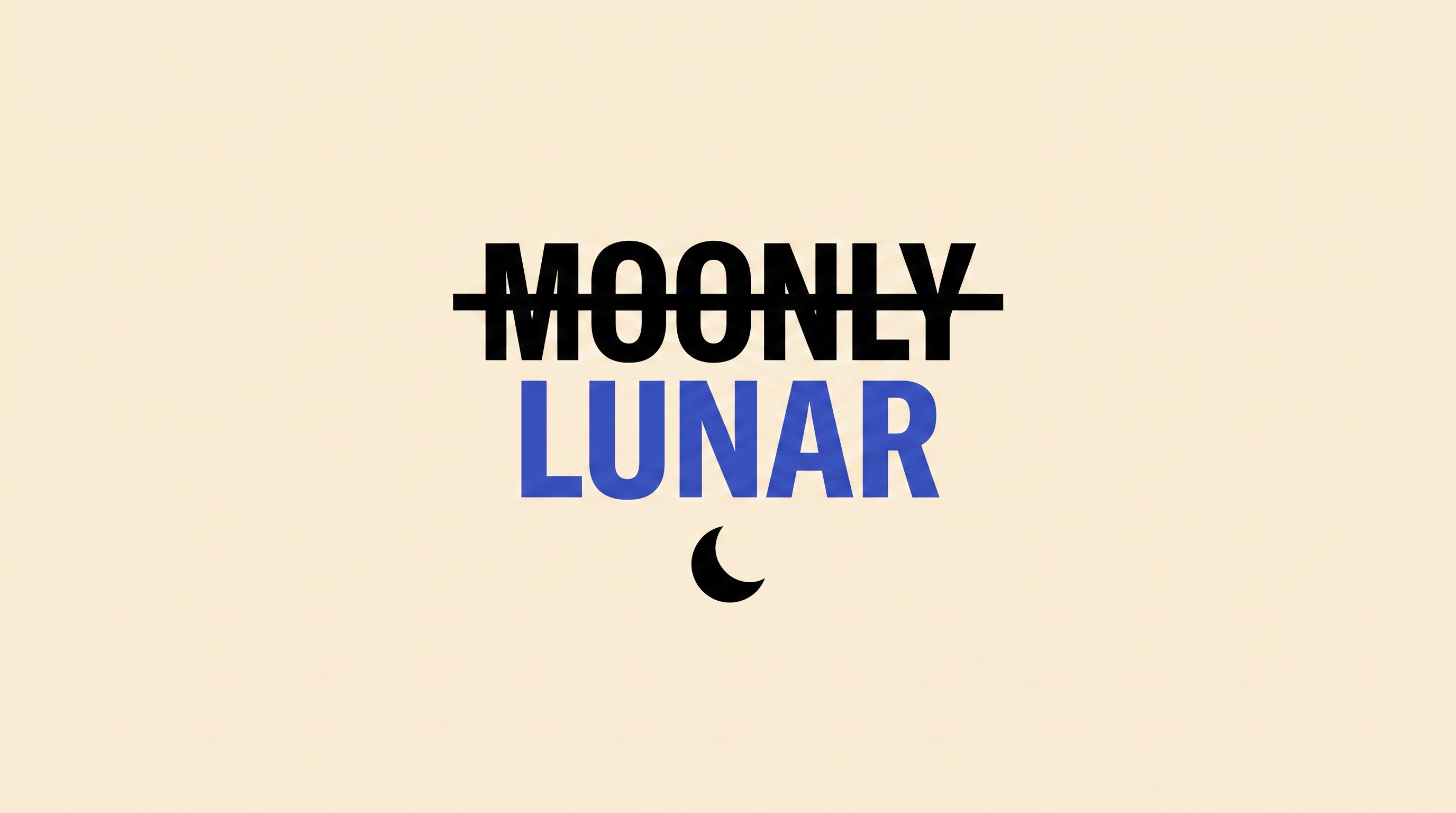
The word MOONLY struck through in black, with the word LUNAR in bold cobalt blue beneath it and a small crescent moon in the corner.

English has a small machine for turning a noun into an adjective. You take the noun, you add -ly, and you walk away.

Friend becomes friendly. Love becomes lovely. Cost becomes costly. A day becomes daily. Nobody teaches you this. You absorb it and then use it for the rest of your life without thinking about it once.

So one evening someone points at the sky and asks why the Moon is not moonly.

And you open your mouth to answer, and nothing comes out.

  • friendfriendly
  • lovelovely
  • costcostly
  • daydaily
  • moonmoonlylunar
  • sunsunlysolar
  • toothtoothlydental
The suffix is free and sitting right there. English uses it, then stops without explaining why.
Crescent Moon photographed from space against a dark sky
The Moon gets two English adjectives — and neither is “moonly.” (NASA / public domain)

The rule that suddenly develops opinions

This is the part that bothers me. It is not that English ran out of ways to make the word. Moonly is easy to say. You understood it instantly just now, and you have never once heard it in your life.

Instead English hands you a completely unrelated word. Lunar. A word with no visible connection to the moon at all, unless you happen to know Latin.

Same for the sun, which gets solar. Same for teeth, which get dental. Same for a cat, which gets feline.

These pairs have a name. They are called collateral adjectives: adjectives tied to a noun by meaning while being completely unrelated to it by descent.[1] The word collateral is doing honest work here. It comes from the sense of belonging to the same family stock but not in a direct line — a cousin, not a child.[1] Moon and lunar are not parent and child. They are two people who happen to have the same job.

Imagine the law passes tonight

Try this. Suppose English passes a law at midnight: every adjective must be grown from its own noun. All borrowed ones are deleted.

Tomorrow morning, astronomers study the moonly surface. Engineers install sunly panels. You book an appointment with a toothly surgeon. Your cat has excellent catly reflexes.

Now notice your own reaction. Nothing there is broken. Every word obeys the rule you already use for friendly and lovely. It is not wrong.

It just sounds like a nine-year-old explaining space.

Which is the actual question. If the words are well-formed, and you understand them perfectly, what exactly did we lose?

English did build the word. It just gave it a different job.

Here is the thing that made me sit up, and it quietly dismantles the whole question.

Moony is a real word. It has been in English since about 1586. And one of its listed meanings is, straightforwardly, relating to or resembling the moon.[6]

So English did make the native adjective. It has been sitting there for four centuries.

But you would never write “a moony eclipse.” Because moony drifted. It now mostly means dreamy, moonstruck, a bit absent — the face of someone in love, not the surface of a rock.[6]

Basically, English did not have a gap. It had a staffing decision. Lunar took the observatory. Moony took the poetry.

The Moon has two adjectives. One went into science. One went into longing. Nobody consulted the Moon.

Why English keeps three words for everything

To understand the decision, you have to look at how English got its vocabulary, which was less a design and more a series of arrivals.

Old English was already here. Then Norman French arrived with the aristocracy, the courts and the schools. Then Latin arrived, and stayed, as the language of the church, scholarship and record-keeping.[3]

English did not replace the old words with the new ones. It stacked them. The result is that modern English often carries three words for one idea, on three levels: the popular one from English, the literary one from French, and the learned one from Latin.[3]

askOld Englishthe kitchen
questionFrenchthe courtroom
interrogateLatinthe report
Ask, question, interrogate. One meaning, three arrivals, three rooms you would use them in.[3]

Rise, mount, ascend. Fire, flame, conflagration. Holy, sacred, consecrated.[3] Every time you pick one of these over the others, you are not just choosing a word. You are choosing a century, and a room.

So when the Renaissance needed a serious adjective for the moon, it did not reach for the farmyard shelf. It reached for the Latin one. Lunar entered English in the early 1400s meaning crescent-shaped, and settled into “pertaining to the moon” by the 1620s.[8]

The traffic warden called blocking

There is also a quieter mechanism at work, and linguists have a name for it: blocking.

The idea, as Aronoff put it, is the non-occurrence of one form due to the simple existence of another.[4] If a word is already doing a job, a perfectly good rule that would produce a rival word quietly gets stopped at the door.

Eg: English has a productive way of making a doer out of a verb. Teach, teacher. Sing, singer. Steal, then — stealer? No. Thief already occupies that seat, so stealer never really gets to sit down.[4] Same with went, which blocks the perfectly logical goed.[4]

By this account, lunar is parked in the space moonly wanted, and moony has drifted to the other side of the room. The rule still works. It just has nowhere to put the result.

Where I have to be honest

Blocking is a tidy story, and tidy stories about language deserve suspicion.

It is not a settled law. Embick and colleagues argue that in word-building of this kind, some forms are ill-formed on their own terms rather than because a rival word exists — that the rival is not always the reason.[5] Blocking is also leaky in plain sight: moony survived, and so did moonlit and moonlike, all sitting comfortably next to lunar without anyone being evicted.

You will also see these pairs called “suppletive adjectives.” That usage exists, but it is a loose and arguably incorrect stretch of the word suppletive, which properly describes cases like good and better.[2]

So: not a law. A pressure. English leans, it does not legislate.

Two words, one rock, two theories

Now the part I actually wanted to tell you.

Moon comes from Old English mōna, and traces back to a reconstructed root meaning “to measure” — the same root that gives us month. The moon was named for being the thing that counts time.[7]

Lunar comes through Latin luna, from a root meaning “light, brightness.” The same root shows up in Old Church Slavonic and Middle Irish words for moon and light.[8]

Read that again slowly.

moonfrom a root meaning “to measure”the Moon as a clock
lunarfrom a root meaning “light”the Moon as a lamp
Same object. Two ancestries. Two completely different answers to what the Moon is for.[7][8]

One set of ancestors looked up and saw a calendar. Another set looked up and saw a lamp. English ended up holding both, and never told anyone.

And the suffix has its own small secret. That -ly comes from Old English -lic, from a root meaning appearance, form, body.[9] So friendly did not originally mean “full of friendship.” It meant something closer to friend-shaped. Having the form of a friend.

Which, if you have ever met certain people, is a distinction worth keeping.

What this is actually about

This was never really about the Moon.

English is not one language pretending to be tidy. It is several centuries of arrivals, stacked, still holding their old jobs. The vocabulary remembers who was in the field and who was at the table — which is why we raise a cow and eat beef, one word from the farmers, one from the people being served.

Words are sediment. You can read the layers if you dig.

So why isn’t the Moon moonly?

Because English already had a word for the Moon’s time and a word for the Moon’s light, and somewhere along the way it decided that one of them should put on a lab coat.

Moony is still around. It just took the poetry instead of the astronomy — which, for something that spends every night hanging over the sea doing nothing in particular, is arguably the more moonly career.

References

Sources used in this article

  1. [1] What is a Collateral Adjective? Merriam-Webster
  2. [2] Collateral adjective Wikipedia
  3. [3] Borrowing in Middle English Towson University
  4. [4] Blocking (linguistics) Wikipedia, after Aronoff, Word Formation in Generative Grammar, 1976
  5. [5] Blocking effects Embick, Benz & Paparounas, University of Pennsylvania
  6. [6] moony, adjective Merriam-Webster
  7. [7] moon, etymology Online Etymology Dictionary
  8. [8] lunar, etymology Online Etymology Dictionary
  9. [9] -ly, suffix etymology Online Etymology Dictionary